Wednesday, 14 December 2011

Preliminary Task: Editing

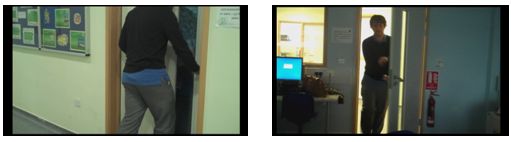
 After we finished filming it was time to edit. We had to cut down many scenes as they ran for too long so we spliced the bits we wanted.once the scenes were cut we began to put them in order and used a dissolve effect for the magic transformation parts.

After that was done it was time to add sound. Putting the sound in we found many problems. There was a lot to be and some bits even needed to be muted like when the camera is focused on the card on the wall. It took half a week but finally everything was done and hopefully when we come to do our thriller, learning from our mistakes and experience of editing, we can have better and sharper editing.

Tuesday, 13 December 2011

Source Code

Director: Duncan Jones
Writer: Ben Ripley
Stars: Jake Gyllenhaal, Michelle Monaghan and Vera Famiga


Source Code is an action thriller about a soldier who wakes up in the body of another man and discovers he is part of a mission to find the bomber of a Chicago commuter train.
Box Office
Budget:$32,000,000 estimated
Opening weekend: $14,812,094 in the USA with 2961 screens showing film
Gross: $54,696,902 from USA on the 10/07/2011

So what makes this is a 'thriller'?
There's non-stop action as he only has eight minutes each time on the train to find the bomber, there's a twist as we find out that Jake Gyllenhaal's character is actually injured and on life support as he lost his arms and his body below the waist. And suspense is built as we start to question: is he going to find the bomber and stop the other attack from happening in time?
This is also an unconventional thriller as the main character dies and the people on the train can not be saved.
The film also has an element of a psychological thriller, constantly questioning what is going on? As the film is unclear at times, the main character doesn't know what's going and neither does the audience making you feel on the edge of your seats. The end of the film especially is interesting as it is unclear if he has re-written history or is the ending all in his mind as he has died.
There is a detective element as the main character is trying to find out who is the bomber, and will he find the bomb in time.

Monday, 12 December 2011

Preliminary Task: in the making

When we started to film the preliminary task we noticed that it was going to take alot of editing  to produce the idea/story. So decided as a group to change the story completely. The new story is character A walks into a room where a group of boys are talking, he gets their attention by performing a magic transformation into another person! He then introduces his next trick, a pack of cards he performs the card trick but despite being overly confident the trick doesn't work, to keep his dignity he transforms back to his normal self and leaves the room. IMG00023-20111205-1225.jpg
So above is the storyboard, and hopefully soon the video of the preliminary task will be uploaded!


Sunday, 4 December 2011

Preliminary task: in the making

So on Friday we started to film a couple of scenes for the task. The story is about a magician who goes on a talent show and performs a magic trick that doesn't go to plan, he throws the card at the judges then storms out the room, the judges pick up the card and realise that's the card. Magic!
So we so far have filmed couple of scenes, we filmed when Ezekiel walks into the room and demonstrating match-on action here. When he enters he stopes and looks at the sign, here we used eyeliner match and now we have to film couple of more scenes then edit away!

Sunday, 27 November 2011

Continuity editing

In the preliminary task we must show a demonstration of continuous editing, it must show: match-on action, shot/reverse shot, 180 degree rule and eyeline match.
Continuity editing is to 'smooth over' parts of the editing process to establish logic between two shots to do this devices such as match-on-action is used to achieve this effect.
Match-on action
Match-on action is when we see a character start an action in one shot; which is then continued in the next shot.
Example:


Shot/reverse shot
This is used to show characters having a conversation, this technique makes that conversation more interesting than watching two people talking in one shot.
Example from 'Sin City' :


The 180 degree rule
This is a basic guideline which states that 2 characters (or other elements) in the same scene should always have the same left/right relationship to each other. If the camera pauses over the imaginary axis connecting the 2 subjects, is called 'crossing the line.'


Eyeline match
This is when we see the character look at an object and their eyeline direction follows to the object or person they're looking at.
Example:


Task layout
Character A walks towards a closed door, character A enters through the door and crosses a room to where character B is seated. Character A and B exchange a short conversation, there is at least one use of eyeline match. Either character A or B exits the room.

Ideas:  teacher and student conversation
            an awkward conversation
            a party
            office

Tuesday, 22 November 2011

Paranormal Activity

Director: Oren Peli
Writers: Oren Peli
Stars: Katie Featherston, Micah Sloat and  Mark Fredichs
After moving to a suburban home, a couple become tormented nightly by a demonic entity.

Sales

The estimated cost of the movie was $15,000, the film was shown in only 12 screens in America released on the 27th of September 2009 it took in on its opening weekend $77,873. It’s been estimated that the film has made $193,355,800 worldwide all together when added up last year.

Main problem with these type of films

The main problem the horror genre faces is to make the supernatural believable, in order to make these films believable we the audience need to identify with the story and characters. For example there is always a sceptic, who we identify with normality, during the film as the plot thickens when the sceptic starts to believe we also get drawn in and believe.
There are many scenes in the film that are in the daylight when the characters are analysing what’s happened the night before, this emphasises that they are normal people and the daylight being relatable to everyday life. We see Katie’s friends round making it more believable, constant use of date/time linking with reality again and the amateurish filming makes us think we could film this ourselves!
Sometimes in these films ‘experts’ are brought in, like Peter Cushing in Hammer Horror films. Dr Fredericks, Dr Abraham are the experts in the film and even the internet which is a modern source of information we all use today.

Why this film is effective

The film is captured through a handheld camera, the camera is our eyes in the film and also makes the film realistic as it makes us feel like we’re there like for example when Katie’s sleepwalking it seems like we’re looking for her too. At night we see everything that is happening when the couple are sleeping making them seem more vulnerable.
There is no non-diegetic sound which makes everything seem more unpredictable and tense and we don’t know what’s going to happen next. The simplest of noises become scary and selective use of volume makes us jump when loud. The film is in low-key lighting, use of light/darkness and shadow the bed is partially in light and surrounded by dark/evil. The darkness make us the audience also struggle like the character as we can barely see what’s happening.
The film is constantly building to a climax and the demon gradually is getting stronger and confident as each night the attacks/torment intensifies leaving the characters more paranoid and frightened. Seems more paranoid and scared the characters become the more violent the supernatural attacks become.

Monday, 14 November 2011

127 Hours

Director: Danny Boyle
Writers: Danny Boyle and Simon Beaufoy
Original novel author: Aron Ralston
Stars: James Franco, Kate Mara and Amber Tamblyn
Aron (Franco) goes on a weekend rock climbing trip; and doesn’t tell any of his family and friends where he is going. He’s arm becomes trapped by a boulder and the film follows his struggle to survive.

“Thrillers are characterized by fast pacing frequent action”
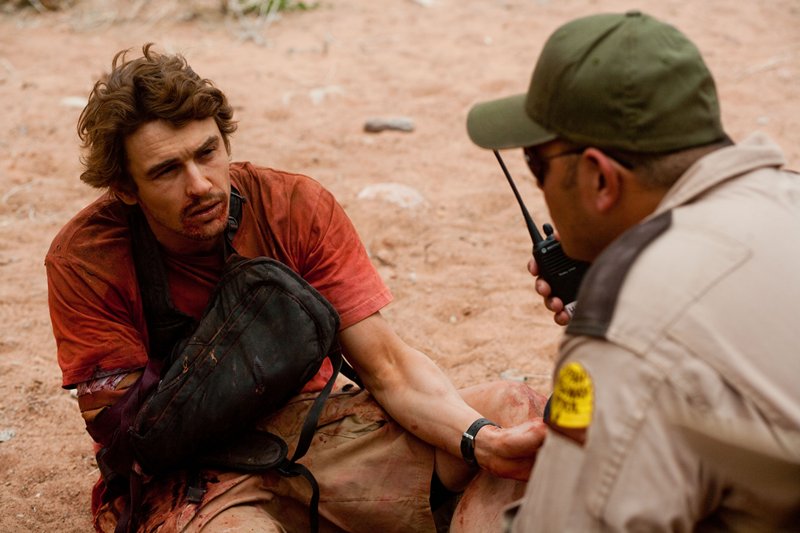
The whole film kept me clinging to my seat; there is constant action and tense moments. At the start we see how Aron’s life was before the accident and how active he is, as he’s walking though and following his hand along the rocks we the audience are constantly waiting for his hand to get caught, however sadistic that sounds.
When his hand gets caught between the side and the boulder Aron first panics and desperately calls for help, as any human being would, but his call for help fails. Aron is constantly trying to move this rock and comes up with many plans to do so. We see the character lose his sane state of mind during the middle of the film; and towards the end is when he decides the only way to get out is to cut out his arm.
 
“Devices such as suspense, red herrings and cliff hangers”
Suspense is created first when we the audience are waiting for Aron’s hand to get caught, just clinging to our seats waiting. Then when he’s cutting off his arm in order to survive and get out of there we’re watching in horror and wondering: is he going to do it?

At the start of the film there are many opportunities where Aron could have got his arm trapped, Boyle uses these red herrings to mislead us and keep the audience stuck to the screen waiting...
The end of the film we see Aron get free from the boulder and trying to get help, he’s walking in the desert looking for help all seems bleak until he sees three figures in the distance and they get help. More help arrives and then emergency forces finally, after the uncertainty, Aron is rescued.